Engage Media has done incredible work in documenting some of the stories of people & communities in Asia. Some of my favs are the Punks who use their music to do activism and help their communities, and the amazing work Andrew Garton has done with Sarawak, documenting how their traditional lives in forest communities has been changed & is at risk of being lost.
It's just over half way funded, pls help it get through, & spread the word to your friends. I think the world needs to hear more of these Voices - they're doing important work
cicada is a collection of artists who work with landscape - urban, natural, constructed and imagined... a combination of results occur, including site-specific installations, performances and interactive pieces... cicada also make other bits of sound+image works for theatre, dance and performance projects... and occational urban gifts of unexpected enlightenment...
Cicada projects have included :
* Mob - an installation exploring the crowd as a discrete organism.
* Saltmilk and other wonders - work resulting from a residency in the West Australian wheat town of Kellerberrin.
* Amensal - an interactive street level installation, a purely negative urban symbiosis.
* Re_Squared - an immersive outdoor audio visual performance celebrating moments of discovered beauty in the city.
I wanted to find out more about this artform and technique, so I googled (without much luck, due to googling the wrong things) and asked the Sarai Reader list and received lots of helpful information from many people. after reading about it, it reminds me a bit of an equivalent to multi-media, or even video blogging from a few hundred years ago. multiple paintings / panels on scrolls (equating to video frames?) are read and music played whilst they're read, so there's a mixture of images, music, text, written / spoken word. the artists travel to different villages - equivalent to the communication methods / networks of today transmitting the multimedia messages & works. originally the works were made on cloth using vegetable based paints but these days modern paints are used and most works are done on paper. I hope the traditional methods are not lost completely! the style of painting comes from Orissa, West Bengal & Bangladesh. modern artists use both traditional, classical topics as well as current topics & stories - they are trying out new variations of the art too, to keep the method alive and to learn new techniques & skills.
I made a video for VloMo08 day16 explaining how I found out information about Patta Chitra Katha :
looking for digital arts, new media & urban research projects or exhibitions in mumbai - I'm only here for 2 weekends so might not make it to any festivals. here's some I found so far - some are past projects & some are not strictly mumbai based but I came across them whilst following links for mumbai related items
Video makers, media activists, software developers and artists from 15 countries across the Asia-Pacific will be gathering in Sukabumi, West Java from May 19-25 for an online video skills camp. The goal of the camp is to bring together open source software programmers, video makers and media activists to develop the strategic use of online video distribution for social justice and media democracy.
TX-AP is a joint initiative between media activists in Australia and Indonesia. It is organised collaboratively by EngageMedia (Australia), a video sharing website and free software development, training and networking project and Ruangrupa (Indonesia) a non-profit artist initiative supporting the development of art in the cultural context through events, exhibitions, research and documentation. 50 specially invited media activists and artists will be coming to Indonesia to attend the workshop and share their skills and ideas.
The camp will provide a unique opportunity for artists, video makers, software developers and activists to collaborate and share skills in a global context where on-line video communication skills have become an increasingly important strategy for activists.
POPVOX - The People's Choice Awards for Digital Media @ The 5th Annual Vancouver International Digital Festival
ONLY 1 WEEK LEFT TO GET YOUR ENTRIES IN!
Submission Deadline - April 30th 5pm PST
Voting Occurs - May 1 -12th
Winners Announced at Gala Awards - May 23rd
BE THE PEOPLE'S CHOICE IN ONE OF 11 CATEGORIES
Best Digital VFX - Best Animated Short - Best Digital/Viral Campaign - Best User Generated / Crowdsourced Content Site - Best Score - Best Game for Console / PC - Best Casual Game - Best Mobile Application - Best Mobile Game - The Do-Gooder Award for Best Venture Dedicated to Social Change - The Homegrown Award for Best BC Based Venture!
The PopVox Peoples Choice Awards for Digital Media have returned for the 2008 season and we invite the digital media community at large to participate in this annual celebration of international talent.
For the MLA Rushkoff course Technologies of Persuasion last week we had to read a couple of articles and watch a BBC video called Century of the Self. I've watched part 1 so far. it goes into Freud and his nephew Edward Bernays and his prolific Public Relations career. from the 1920s, where he convinced women to smoke cigarettes by creating a media spectacle using female debutantes in a parade and the slogan "Torches of Freedom", which was previously only a man's habit. then later contributed towards the rise of commercialism both prior to and following the stock market crash in 1929. he worked on many campaigns over the duration of his career and advised & created PR campaigns for numerous corporations, business leaders and government officials, in order to control the masses. he didn't think in single person terms - he thought in thousands of people.
he wrote a few books, one called Propaganda, in 1928 - this is his most important book. Bernays argued that the manipulation of public opinion was a necessary part of democracy:
mind map (so far) of week 1 of Technologies of Persuasion online course.
Why Johnny Can't Program audio lecture - mind map notes. most of these notes are what the speaker, Douglas Rushkoff mentioned in the lecture - I've paraphrased some of it whilst taking notes.
files attached. remove the .txt from .html.txt files (drupal upload seems to be adding the .txt)
one of the other class members, monster (Caroline Jack) has transcribed the audio lecture!, so this would be a more complete / accurate account of it.
Agency considered in the philosophical sense is the capacity of an agent to act in a world. The agency is considered as belonging to that agent, even if that agent represents a fictitious character, or some other non-existent entity. The capacity to act does not at first imply a specific moral dimension to the ability to make the choice to act. Moral agency addresses issues of these type. Human agency is the capacity for human beings to make choices and to impose those choices on the world. It is normally contrasted to natural forces, which are causes involving only unthinking deterministic processes. In this it is subtly distinct from the concept of free will, the philosophical doctrine that our choices are not the product of causal chains, but are significantly free or undetermined. Human agency entails the uncontroversial, weaker claim that humans do in fact make decisions and enact them on the world. How humans come to make decisions, by free choice or other processes, is another issue. The capacity of a human to act as an agent is personal to that human, though considerations of the outcomes flowing from particular acts of human agency for us and others can then be thought to invest a moral component into a given situation wherein an agent has acted, and thus to involve moral agency. If a situation is the consequence of human decision making, persons may be under a duty to apply value judgements to the consequences of their decisions, and held to be responsible for those decisions. Human agency entitles the observer to ask should this have occurred? in a way that would be nonsensical in circumstances lacking human decisions-makers, for example, the impact of Shoemaker-Levy into Jupiter. In certain philosophical traditions (particularly those established by Hegel and Marx), human agency is a collective, historical dynamic, more than a function arising out of individual behavior. Hegel's Geist and Marx's universal class are idealist and materialist expressions of this idea of humans treated as social beings, organized to act in concert. A similar use of the term agency can be found in social psychology, referring to the self-efficacy of a person, the ability of a person to act on his own behalf. [1]
everything stays pretty much the same
donald trump
he doesn't think twice about anything
that's where his power really comes from
he's got an other type of brain
it's this other type of brain that dominates
media literacy / teachers
trying to break 2000 years or more of cultural programming
this is the centre of something more radical than any revolution
DR: "I don't think we can quite frankly"
whenever a new medium arises
we end up teaching the "literacy of the last one"
history : we get text
God says to Abraham, "you'll be a nation of priests"
which means, you'll be a nation of people who can read and write
priests - heiroglyphs - the only people who could read & write; and pharoahs
we actually got a small number of rabbis / priests who could read and write, mostly just read..
plus a nation of 'hearers'
printing press - renaissance period
a way to write books
did we get a civilisation of 'writers'?
no - we got a civilisation of 'readers'
deconstruct things
internet
now we get a civilisation of writers
blogs
what we should have by now, is a civilisation of programmers
either you're programming, or you're programmed
the technology that people are using on internet now, the interface / internet / conduit they are using is still circumscribed by the same corporate interests that controlled your parents
time warner / AOL
now, instead of people paying to watch Warner Brothers content, people pay them to upload their own content. who cares? it's the same money - going to the same people
now, instead of doing this thing we think of as consumption, we're doing this other thing, that we think of as production, which is actually consumption
we work during the day, we come home and buy a video camera and pay the ISP and then upload the videos / productions that we made. and maybe they won't sue us for using their ideas & icons from popular culture
crowdsourcing
the money equation is the same
we're not actually looking at money and it's biases and how it's created
people's activity - renaissance / corporate way of creating people's media that we're building
what is energizing the rhizome?
cash !
the real currency that is moving through all of this
kids
they speak the language of this new media
they are developing the new languages
adults
are we anthropologists?
studying the kids? looking for the next big thing
or are we looking at the kids from a corporations pov
eg how do we subvert this behaviour
how do we make what they're doing, about what we're doing?
how do we make this communications revolution into a content revolution
"content is king" - the message of the past decade
first there was devaluing of personal contact & communication between people
and instead, value what content the corporations were outputting
then people started using that content as a medium of exchange
and the corporations replied with 'oh you can't use that - we own that'
which shows how little the corporations know about interactivity
and how much the corporations know about marketing
communications revolution
childrens tv programmes
they needed funding to produce the shows so the plush toys industry was started
idea came from Japan where this was already successful, eg Transformers toys
biases of media
if the bias of the media is to create the promotion & selling of the toys, then the stories themselves will change
eg fantasy universes that are unconciously designed to promote the sale of toys
that's why evolution became popular in Japan
when you have evolution, you constantly have new models
basic media literacy
the bias of the media changes
new media
this was the opportunity to change focus
when TV was introduced there was an initial small change in focus
people watched and produced educational programs
but these didn't turn out to be the most popular in the end
emails, laptops, computers everywhere
problem
on one hand, we have these tools that give us an inkling of our power as human beings to be the authors of our reality, of the very society that we're living in
on the other hand, we're in a society where we are so pressured to create applicable skills, that we lose sight of that
education conferences these days
are often about creating the "marketable student"; the "marketable graduate"
there's a lot of people putting money into creating these marketable skills
they're saying "how're we going to compete with the Chinese, the people in Bangalore"
but they may have to let students in on the fact that there is a conflict - between trying to promote real lateral thinking and the ability to create, and construct an argument.
same things they're trying to do in academy
some of the students are asking, 'why do we have to read McLuhan - these old white Europeans'
Walter Jackson Ong, S.J. (1912-2003) was a professor of English at Saint Louis University for over thirty years. Over the course of his career, Ong wrote a number of groundbreaking studies in the fields of orality and literacy studies. Some of these works include Orality and Literacy: The Technologizing of the Word, The Presence of the Word, and Ramus, Method, and the Decay of Dialogue.
you thought of the computer as a modelling environment
you thought of that as a place where anything could happen
that was a radically different way of understanding the tool, for those of us who had been raised on televison
because now we didn't think of the tv as a place to get programmed
we thought of a tv event, because that's what the monitor was, as a place to build a world
and then we started to look at other things in our world and wonder how they were programmed also
what else is a social construction
why are the roads in my town built this way?
it's not that God put them there
some people, at some point decided where they would be
and those people had certain agendas
either they wanted traffic to move quickly
they wanted people to stop at stores
why are the streetcars gone?
so this makes you think, why don't we use streetcars any more?
well, because this big company made a lot of money in a sort of corrupt way, and wanted streetcars out so we'd all have to buy cars
all of this happened
and it's not a matter of studying conspiracy theory
it's a matter of understanding, that the world we live in - a lot of it has been intentionally programmed with certain biases
and that most of the people who did that programming, are dead
and most people living in this world, don't even have access to the way it was programmed, or even to the IDEA that it WAS programmed. to the NOTION that it was programmed. that people had intent
so, playing with computers, most importantly, opened that
the idea that the world we live in has been programmed with certain biases
breaking down media opens you to this idea
and once you realise how a tv commercial is put together, you can understand how a politicians speech is put together.
you understand how everything is put together
once you work out how this is done, it's the acid trip moment, that so frightens the people who's money is in mainstream media
and that's why they undo all the feedbacks
I (Rushkoff) always talk about the effects of the remote control & how it helps to deconstruct media
the joystick, which helps us to demistify the interface
and the computer keyboard and the mouse that turns it (the computer) from a receiver, into a portal, into a do it yourself medium
but fear and money concerns undid this, very skillfully, undid these effects
and kids who are using the remote, were considered to have a shortened attention span
and they start misusing the diagnosis of ADHD to be applied to anyone who is capable of being resistive to media programming
the transparent interfaces of the 1980s and 1990s get replaced with Windows, and what is Windows about?
the main communication of Windows is not about "we make the computer easier for you to use"
the main communication of Windows is about "stay back", "we will use the computer for you"
how do you install a program in Windows?
you invoke the Wizard
why did they pick the Wizard? it's not the "helper"
it's the Wizard. because they're saying this is mysterious
this is magical
only the Wizard can move the applications into the applications folder
do not touch it
no user serviceable parts inside
a shift from contact (to content - on the internet)
people were online, and talking to each other
in 1994, they found that the average family that had internet connection was watching 9 hours less television a week
this was a problem
so then they said, "let's not make the internet about contact, let's make it about content"
and they start getting us sidetracked from one another, and engaged yet again with their corporate crap
and they're all happy with us using it, and sending it around, and being all viral until it gets into their Digital Rights
now try using Windows Vista
Vista is an operating system literally crippled by it's DRM, it's Digital Rights Management provisions
so much so, that I (Rushkoff) think this is the most positive thing to happen to linux since it's inception
it's so bad, that you can play something legal that you own, and Windows will come up and say "Windows doesn't think you have the rights to play this video - are you sure you want to proceed"
that's scary
educators
in the case of educators, what happens is that the lack of applications
I'm doing the Technologies of Persuasion online course with Douglas Rushkoff @ Maybe Logic Academy. it started today. there's already a few discussions happening in the course forums - they're moving so fast!
Drishti Media are a group of media professionals working on issues of gender justice, human rights and development. They use video, theatre, radio, other media and the arts to contribute to struggles for a just, humane and peaceful society.
Video Vortex Conference is being held in Amsterdam (NL) on November 30 and December 1 2007. It is organized by the Institute of Network Cultures.
Themes of the conference include:
Viral Video critique
Vlogging Critique
Participatory Culture, Participatory Video
Real World Tools and Technologies
Theory & History of the Database
Narrative and the Cinematic
Database Taxonomy and Navigation
Internet Video: Art, Activism, and Public Media
Evening Programme / Exhibition
The First International Art Tech Media Congress has been set up in order to reflect upon and analyse questions currently being raised about art and new technological media within an international context.
artechmedia.net is calling on all creatives of the world to participate. Submissions will be accepted from the following categories:
A
- Video art
- Net-art
- 2D & 3D Computer Animation
- Blog, videoblog
- Creation for mobile platforms
- Digital Music
- Videodance
B
- Digital Communities
- Geospatial storytelling
- Artificial Life, Software art, Transgenic art, Generative art
today it's time for the Americans to vote, and I hope they turn out to the polls in droves, if not for themselves but for the other countries who are affected by decisions made in US politics.
as it's that time of year, there's been a few articles floating round the maillists. one which caught my eye was on google bombing, or link bombing as it's also known. the article in the New York Times called Gaming the Search Engine, in a Political Season describes google bombing as :
[quote]
"A GOOGLE bomb — which some Web gurus have suggested is perhaps better called a link bomb, in that it affects most search engines — has typically been thought of as something between a prank and a form of protest. The idea is to select a certain search term or phrase ("borrowed time," for example), and then try to force a certain Web site (say, the Pentagon's official Donald H. Rumsfeld profile) to appear at or near the top of a search engine's results whenever that term is queried."
[/quote]
I guess time will tell if these techniques are effective - from what the article says they're definitely changing the search engine results. But I suspect the key to the campaign is finding the best search phrase to use. Personally I don't think I'd search google for "borrowed time" - I can imagine this being used in a viral email though like the ones in the past where people say type this phrase and hit I feel lucky into google. Perhaps this is a case of preaching to the converted though which is often the problem with activist and social protest issues.
Let's just hope the spammers don't get onto it as well. Hopefully there are algorithms to prevent this in the search engines, though I wouldn't be surprised if this were one of the SEO tools for spam sites!

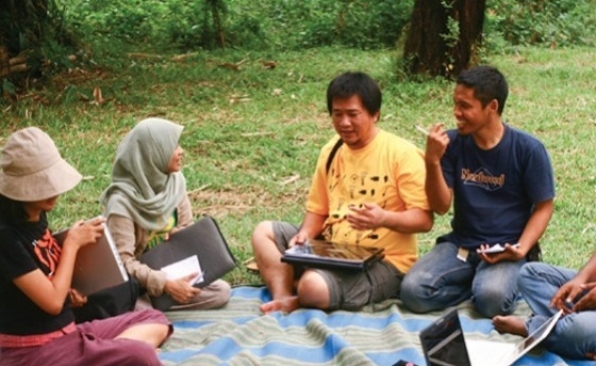
 Video makers, media activists, software developers and artists from 15 countries across the Asia-Pacific will be gathering in Sukabumi, West Java from May 19-25 for an online video skills camp. The goal of the camp is to bring together open source software programmers, video makers and media activists to develop the strategic use of online video distribution for social justice and media democracy.
