I've been thinking about different publishing & distribution methods and as it often happens the conversation appears on a site or mail list around the same time. early in feb, the node-l (node-London) promo emails starting making the rounds of the net lists. it sounds like a great collective of grassroots, funded & professional new media organisations based in London. (read through the list of projects on their site!) initially I was thinking this would be great to have internationally or at least in Australia / New Zealand as well - node-b (brisbane), node-s (sydney), node-m (melbourne), node-a (auckland) or node-au (australia) & node-nz (new zealand). another section of their promo which caught my eye was the POD - print on demand. I followed the links and discovered the mute site is based on CiviCRM which is an offshoot of Drupal (basically it's Drupal with a nice installer and some extra custom themes). Drupal's my favourite CMS as anyone who knows me would know - this site is done in drupal. (finally upgraded to latest version, but haven't had time to add more features yet). anyway, the POD concept is quite cool. people could make their own custom pdfs. researchers could pdf their reference articles for research. endless possibilities. I might try out the 'save to pdf' feature. on the Stealth message board I frequent, Mark was talking about new concepts & suggestions for Stealth mag, so I posted the below message. there's heaps of other options but not sure if he's wanting to go the online publishing method. I think it would work well in conjunction with the print mag and he seems quite busy these days & it sounds like he has to do most of the work which would be quite a lot of work.
I've been reading some of the notes on the Notes about Notes blog (written by a guy who works for Eastgate who make Tinderbox and the site is made using Tinderbox, so perhaps a touch biased? but interesting anyway). The note about commonplace books touched base with me.
I've been watching the identity 2.0 presentations from 2005 oscon and web 2.0 conferences. I'd been meaning to watch more of the presentations from these conferences but hadn't got round to it yet. I came across this again via another site, presentation zen blog, which was talking about different styles of presentations - Dick Hardt from sxip.com (pronounced skip) was recommended as having good presentation style. He in turn borrowed this style from Lawrence Lessig, the well known copyright lawyer and advocate. They both use many slides with short phrases or single words, with a scattering of images and are displayed with a fast pace. It does make the presentation more interesting! - well compared to the traditional powerpoint style anyway. This topic has been on my mind recently - not presentations per se, but events and conferences - as the iDC mail list has been having interesting discussions about the different styles of presentations at digital arts / music / new media conferences. Mostly the conversations have been regarding providing remote connections and contributions for people to attend the conferences remotely either during the conference or after it. Discussions on presentation style came up - different ideas, particularly wrt academics presenting papers and just reading them to the audience when they may have been available prior to the conference, then running out of time for questions. Anyway, I find it interesting as I'm not able to attend all the conferences I'd like to, though I try to attend as many as feasible, but it's really handy to be able to watch a video or listen to audio of the presentations after the conference. I find most of the larger IT based American conferences have video lectures / presentations available - perhaps this is because they have deals with ISPs and video production / distribution people. I think videoblogging could help with this as there's many more people recording video these days, but I suppose it won't be videoblogging as such, but using videobloggers to apply their skills to provide documentation and video on the web. Really useful for online education also!
Ever been on a drive where the countryside is so beautiful it's hard to pick the most beautiful part of it. I took some video - the collage doesn't do the day justice but perhaps gives some idea. There was so much to look at I had to choose some of the finer details to concentrate on.
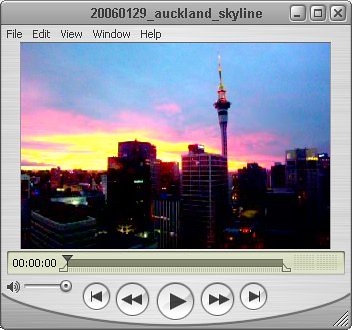
This video was created in eZedia QTI for Windows. I'm trying out the software - you can add interactive components but for this example I didn't. I just left it simple. There's a limit to 5 objects on the trial version as well so I couldn't fit any more objects in without going over save/export limit! The only thing I don't like about it is that I need to host the videos locally (at least all together on another site of mine) instead of using a remote site such as archive.org. Which means if I use this technique again, I'll need to use smaller video files and loop them. Hopefully this doesn't make my site go over bandwidth - it's only a very small webspace. Oh well. See how it goes.
ok, these links aren't all strictly hip hop, but some of the galleries do show some graf, and if you're visiting NZ/Auckland, it's worth checking them out.
in the galleries, there's usually an "Artwalk K Road" brochure created by the K Road Business Association - this is where all these links & descriptions come from. (typos & errors below are mine)
K Road = Karangahape Road, I'll use the abbreviation to save more typos
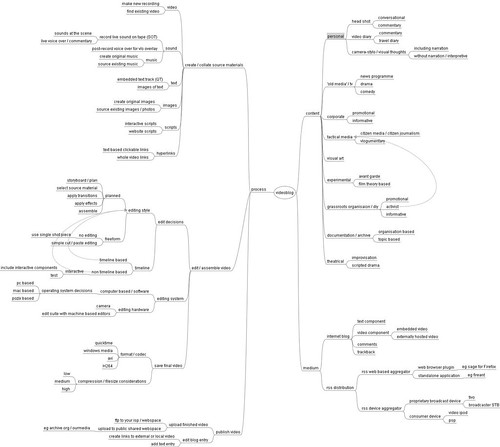
There's been lots of discussion on the vlogtheory yahoogroups list about videoblogging - debates over content, medium etc. I've done up a quick mind map (using sourceforge freemind) to try to collect my thoughts. it may not be completely in line with the ideas of the group, but could be useful as a starting point to capture thoughts, for me at least. I haven't included everything yet, but it's a start.
here's another email sent to vlogtheory yahoogroups list on some thoughts and conversations I've been having today.
thanks for the replies guys.I find observing and loosely analysing communities really interesting. human behaviour in groups I guess. online behaviour is a particular interest.
(likely another non topic message, so delete now if not interested)
ok, it's a really hot sat afternoon here now (Auckland) and I've just returned from lunch and taking photos of street art & graf so have turned on the aircon and am emailing to cool down. at lunch I mentioned videoblogging to my friend, who hadn't really heard of it or realised it had a name. but one of the conversations was the difference between personal blogs and personal videoblogs. the main differentiation I see, is that written blogs (or even books), is really the little voice in your head speaking - letting it have a voice, whereas video diary entries are more real as you see the persons expressions and location not just descriptions of it. so you (the viewer) can connect differently to it. ie almost real vs imaginary, though not imaginary in the context of made up, but rather descriptive / virtual reality open to interpretation - the reality inside your mind compared to reality that you see. (prob not explaining this properly, perhaps I should have had the camera running at the time of the conversation as it was more coherent then).
I sent this email to the vlogtheory yahoogroups list, posting here to keep track of it.
Hi everyone, to change the topic slightly, and I'm not sure if it's really videoblogging theory or related per se, but one thing I like to notice is the changing moods and behaviours of when different technologies or interests are taken up. I've never done actual studies on it, so my thoughts are purely from observations, but I've seen it happen across many fields. do you know what academic studies there might be on these things?
[quote]
..a work from 1973 called A New Design for TV Chair. In it, Paik appropriated an image from a 1940s popular-science magazine that depicts the home viewer of the future watching television. Television had already become a monopolistic industry that was a conduit for advertising, a "communication" industry that operated on a one-way street of information. But in A New Design for TV Chair, Paik posited his own questions to project an alternative future for television:
DO YOU KNOW...?
How soonTV-chair will be available in most museums? How soon artists will have their ownTV channels? How soon wall-to-wallTV for video art will be installed in most homes?
Paik envisioned a different television, a "global groove" of artists' expressions seen as part of an "electronic superhighway" that would be open and free to everyone.The multiple forms of video that Paik developed can be interpreted as an expression of an open medium able to flourish and grow through the imagination and participation of communities and individuals from around the world. Paik, along with many artists working as individuals and within collectives through the 1960s 14 and 1970s to create work for television as well as for alternative spaces, challenged the idea of television as a medium and domain exclusively controlled by a monopoly of broadcasters.
[/quote]
This piece, taken from Nam June Paik's website was written by John Hanhardt of the Guggenheim Museum. I think it's an apt description and I wonder if Nam June Paik would have been happy to see the recent videoblogging community and works becoming more popular on the internet.
reading more saria website articles. from what I can tell whilst reading the Ibarat 01 publication, life in the colony follows different rules than in the cities. local communities are tight-knit. lanes and streets become named after the locals, businesses who inhabit them or are even based on a purely descriptive nature. I suppose this is how early settlement streets in Australian cities were named also - that's why there are so many church streets with churches, railway parades next to the railways, bridge streets with bridges, hill lanes with hills etc. the Indian stories remind me of the City of God / City of Men movie/series where the kids go about creating a map of the favela they live in and the dramas and ego flattering they go through to offer naming rights to prominent community members.
it'd be interesting to see the work Sarai is doing whilst in country if I get the chance. they have a range of projects with visiting contributors as well as in-house fellows working in different areas.
it looks like my next work project is in Delhi, India so I've been reading more of the sarai website contributions. the Cybermohalla scratchbook is quite interesting - a collection of writings, thoughts, images and texts from the members contributing at the Compughar. many of the people are from the villages and settlements. it's interesting to read their thoughts and observations of the spaces they live in.
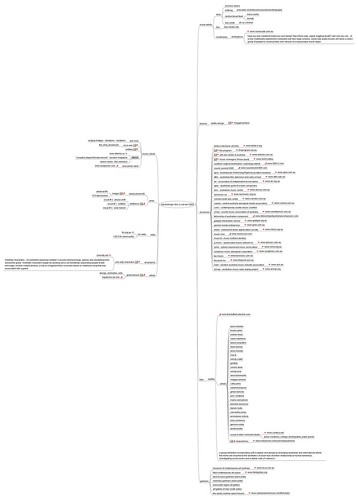
I've finally gone through the bag I brought back from electrofringe / this is not art 2005. haven't had time to write it up, so I'm trying a mind map from sourceforge's freemind instead.
have you ever wanted to build your own being? free it from pain, regret, niggling doubt? well now you can... in a new multimedia experiment conducted over four large screens, synarcade audio-visuals will allow a select group of people to construct their own version of a responsible moral citizen
a group exhibition incorporating soft sculpture and design by emerging australian and international artists. the works are inspired by the aesthetics of plush toys and their relationship to human behaviour, investigating social norms and a darker side of 'cuteness'
OneSixty Characters – An exhibition exploring children’s nursery rhymes/songs, games and storytelling from around the globe OneSixty Characters began by sending out a call worldwide requesting people to text message, via their mobile phones, a line or a fragment from a nursery rhyme or childhood song that was associated with a game