The 4th annual Carnival of e-Creativity (CeC 2009) is scheduled to be held February 27 to March 1, 2009, in the sylvan spaces of Sattal Estate, just above Bhimtal, near Nainital, in the Lower Kumaon of the new Himalayan Indian state of Uttarakhand.
As always, this will be about Presentations, Performances, Exhibits, Meetings, and Screenings, involving direct and indirect participation of e-Creative Practitioners of all description from around India and the world, spread over 3 days of intense private, and also public, creative interaction.
Organizers :
The Academy of Electronic Arts (The AeA) is a Private Trust that serves as a learning, sharing, mentoring, networking, benchmarking, empowering and broadly inclusive, but non-educational, institution.
Managing Trustee of The AeA & Incident Director for CeC 2009: Shankar Barua
Co-Curator: Ima Pico (Spain)
Co-Curator: Wilfried Agricola de Cologne (Germany)
Co-Curator: Moritz Neumuller (Spain)
perhaps this is a very generalised, naive interpretation of one of the mumbai terrorist's confessions, but after reading the article, these are my initial impressions (stream of consciousness - spelling / grammar mistakes & all). I replied to the mail list with most of below (but have added extra thoughts since). it made me sad to read this article as I cannot understand how this person could be thinking.
last post for VoMo08 is some of Gandhi's words from my visit to his Bombay residence on 15/11. music is "Claire's Theme" by Graeme Revell from the soundtrack to one of my favourite films "Until the End of the World"
it's been quite a month - sometimes hard to work out what to post each day, some posts were posted late. but all are little memories of this month so I can remember them later
not very exciting video - it's of the plane + waiting for the car at Delhi domestic airport - but I've never been so relieved to catch a flight before. even though I was safe in mumbai, it was unsettling to be there so I was happy to be going home. I was worried that my flight might be delayed or cancelled but everything went smoothly. the army was at the airport and they did all the security checks. it was probably the most efficient trip out of India I've ever had!
Delhi airport and Mumbai airport is much nicer now that it's been renovated. delhi airport was a bit dingy in 2006.
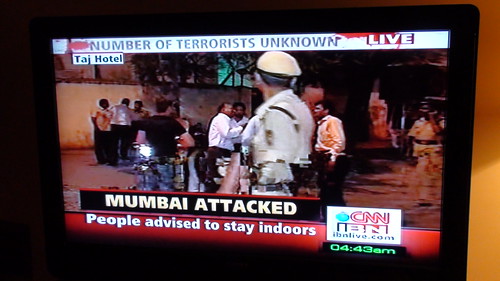
this is one of the main footage scenes that was being showed on tv early morning of Thursday 27th November during the Mumbai attacks. one thing struck me - when the man with the bleeding hand is near the cameraman, the man next to him - perhaps a journalist? - moves his arm so the camera can get a clearer shot. then the cameraman turns and walks to film other people at the scene. it was replayed over and over. I was wondering then - if in a crisis, what would I do? would I film or would I try help the man and stop the bleeding. i hope someone helped this man.
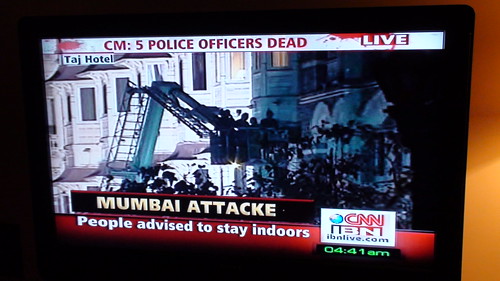
the newsreaders were in shock too. they were talking about the Icon of Mumbai - the Landmark of Mumbai, being targeted. for a while they talked about the artworks inside. they hardly mentioned the people until later.
such shocking pictures were coming in all night. later in the morning the news broadcasters were asked by the police not to show live 'operations' on air in case it would aid the terrorists. I wondered why it took them this long to do this!! I think the journalists & news broadcasters need to be a little more responsible in what they show live.
another scene being repeatedly shown was the one of the ATS (anti-terrorist squad) chief standing outside putting on the bullet proof vest, with hardly any guards near him. then saying he was killed a few minutes later as he led a charge into one of the hotels.
live footage was shown of the police and special agents outside Nariman House. part way through this broadcast the channel was told to stop showing the images. it was very clear to see where the police were standing which I think was putting them in greater risk.
when I was at mumbai airport on thursday afternoon, the tvs in the terminal were all showing the news channels - in English and Hindi. all the broadcasts were showing 'live' pictures, despite being told earlier in the day not to show footage of the operations. I thought this was a bit irresponsible of them!
woke up to a txt msg 3am this morning asking if I was ok - been watching the news since. they're evacuating some people out the windows of the hotel now. one hotel is on fire - mumbai's landmark. it seems to have started about 9:30pm last night. shots still heard fired at one hotel about 10mins ago - hostages still held there - they rounded up the 'westerners'. hostages at cama hospital (women's & children's hospital) still too.
it's now 5:30am - this has been going on for about 7.5 hours! tv reports are repeating the info. but there's regular updates. a car even drove by and shot at the media. there's footage of one man's hand bleeding and the cameraman grabs his arm to move it so he can get a better shot of the blood - then he moves off to another view. hopefully someone actually helped the injured man instead of just filming him!!
update 6am : now they're reporting 87 people killed & over 200 people injured :(
I've just heard fire engines driving past my hotel so hopefully there's not more attacks nearby. so far the news channel (CNN / IBN ibnlive.com) is reporting 3 hotels + 1 hospital have been attacked. they've showed footage of the chief police (?) officer (ATS chief) arriving, putting on his helmet & bullet proof vest, then reporting he was shot in the chest/head (conflicting reports) and killed not long afterwards. apparently he's been under scrutiny since other recent attacks.
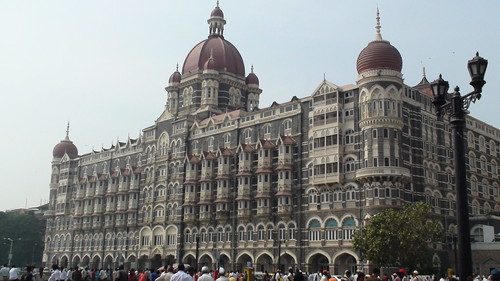
this is what the Taj Mahal Palace looked like a couple of weeks ago 15/11 when I was in the city :
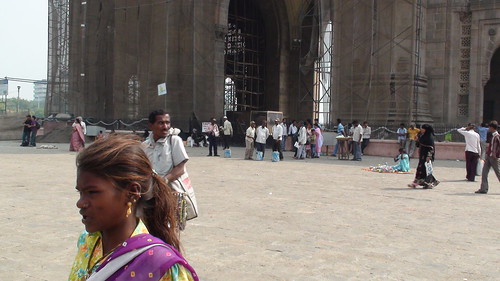
I hope this little girl is ok - she's probably a regular at Gateway of India across the road from the Taj Mahal Palace. she'd given me flowers & didn't want money. unusual for tourist sites. my driver had shown me around the different places, including Leopold Cafe in Colaba.
twitter's #mumbai reported initially live reports, but then changed to delayed confirmed reports after police told media not to show live pictures / details in case the terrorists were watching / monitoring them
update : 21/11/2009 broken ladder - another blog post of mine from 11/12/2008 when I was reading up about one of the guys who'd been involved in the attacks and was put in jail
when the rickshaw dropped me off after work, I walked past a marquee next to the hotel. there were people setting up the chairs etc. later that evening I could hear drumming from outside and I could see the drummers and a lady dancing to the beat. I went outside but couldn't hear it as clearly and couldn't see them. so I went to level 7 and then back to level 2 where my room was and zoomed in. the audio isn't great as I can hear the hotel muzac mixed in. but the lady seemed to be enjoying herself. the people here show so much joy at parties, despite the places they live in and the things that go on around them. it's an amazing thing to see.
my head's a little blurry now after all that happened following this in the city, but I think this was around the time the attacks started in South Mumbai - perhaps an hour or so prior. the party only lasted about an hour. maybe it was a wedding reception.
26/11/2008
VloMo08 : day 26
Mumbai, India
I haven't had reliable net access so uploading late now that I'm home.
another rickshaw ride home. there was a car accident when we stopped prior to turning into my hotel's street. I couldn't see the damage but I can hear the crunch as the car hits another car. i was trying to hold the camera still but the footage is very jumpy - I tried to capture some of the road - this is why the footage is jumpy - the roads in mumbai are not very good! which makes the traffic worse as everyone tries to dodge the potholes. it's worse in monsoon season as the holes get bigger with the rain.
there's so many dogs in India - they spend half the day sleeping as it's so hot to do anything else. they're often seen sleeping under cars in the shade. so mangy looking but cute too.
VloMo08 : day24 - sleeping dogs in Mumbai
24/11/2008
it's hard to find a good coffee in india - this is one from mumbai. there's a couple of coffee shop chains : Cafe Coffee Day & Barista. they're not too bad. but I've been spoiled by the Australian coffee shops
in January if you look at the sky in Delhi (& likely other parts of India) you'll see the kids on the roof of the apartment buildings flying kites. they do this in the festival season
this evening as we were leaving I saw a boy on a roof near the road flying a kite so I grabbed the camera
sorry I probably didn't explain it properly and the guys I was with didn't want to speak on camera
in january there's a kite festival - in delhi on this day there's more kites than birds in the sky and children on the flat roofs of the apartment blocks flying the kites. so I always look out for them now. but there seems to be less other times of the year. so this was a nice surprise across the road from the office as we were leaving work this afternoon - to see a boy flying a kite and a few others in the sky.
this video was taken in mumbai but I've spent more time in delhi - so it's always interesting to see the similarities / differences in the different cities, as the languages, religions and some customs are different in different regions in india.
Kite Festival
14 January is celebrated in India as Makar Sankranti - heralding the transition of the sun into the Northern hemisphere. It is also a big kite day in most parts of India when children from 6 to 60 can be seen with their heads turned to the sky. In Jaipur kites virtually blot out the sky. Everyone joins in this riotous celebration and shouts of " Woh Kata Hai !" reverberate from rooftops to the accompaniment of drums as adversaries’ kites are cut down. And everyone’s an adversary! Any kite in the sky is fair game.
I think there's at least a couple of hundred stories & characters to be written from any street scene.
this one's zoomed in on my Nokia N95 - the video quality isn't that good when you zoom in to record video, but it's good enough for a reminder for me. I'm playing it at 1/2 speed - not sure if that saves or not.
I didn't capture the women in black unfortunately - will try again next week.
in Mumbai they have black and yellow cabs and powder blue cabs. I love the seats and the old steering wheels & gear shift control on the steering wheel, single front bench seat, door handles & windown winders. they remind me of a cross between the old Holden cars (Mum had one whilst growing up - I've seen the photo) and the old Hilman Hunter car Mum had when we were growing up. though it had split seats in the front. these cars have new motors - they're just built in the old shape - ambassador car style as the tourists and locals like them this way.
in other cities the cabs are similar but different colours - eg they're white in delhi, and there's a 'cool cab' variation which means it's got air conditioning, and costs slightly more.
this ride cost Rs50 but I gave him 100 since he didn't try to rip me off like the other driver. the meter is on the outside of the cab but it didn't work. it's probably been broken whilst driving at some stage. I think it'd be safer to put it inside like in the rickshaws.
if I was a writer I think India would the perfect place to come to be inspired for creating stories and characters. whenever I drive past the little stores and street stalls and people walking around I imagine their lives and stories. I wish I could capture it with the camera, though I don't like zooming in on people much and it's impossible to capture the essence properly whilst driving past anyway. plus the roads are so bad, that it's hard to even hold the camera stable. I like reading books by local authors, especially if they talk about street / urban stories. Rohinton Mistry is a great author for these things. the books & stories I've bought recently have been great too but they seem to be more middle class stories. I'd like to hear more from the poorer people to see what they're thinking.
my laundry is back - this trip I had bad luck with laundry - it's taken 3 days to wash my clothes, which meant I ran out this morning. it's my own fault really - I should have asked for the form on the first day, and I should have either brought more underwear or put the clothes in to be washed sooner.
the first day the form was missing so when I came home in the evening there was a note saying they couldn't do the laundry as I hadn't completed the form. fair enough - I was half expecting this to happen but thought I might be lucky. they left forms and I filled one in and submitted the laundry again yesterday.
the second day, yesterday, I came back in the evening one of my shirts was on the bed with a 'customer confirmation' note asking me to confirm that there was a hole in my shirt. it's an old shirt, so yes there was a hole. I called them and said it was ok / confirmed and they collected the shirt, but said this had held up the whole wash. so instead of washing the other clothes and leaving this shirt out, none of my clothes were washed.
which meant I'd run out of clothes for today! so I was washing underwear out this morning in the sink and drying it with the hairdryer. a fun way to spend the morning!
in thinking about this - it is similar to many other things that happen here. people don't seem to be as empowered to make small decisions. I've seen it at work in various departments and also whilst out & about & at the hotels in many visits to india. there seems to be one person to do one small task in the chain of an overall task, and they can't complete their step without approval. which means there's delays further down the line or something is passed on without being checked / worked on. at least the hotel notified me of the problem! I read similar behaviours / scenarios in the "Globality" book as I was flying to India so I don't think my experiences are unique. it sounds like it's a common experience for many companies doing business here. some people get really annoyed & angry about it. I think it's best to understand the reasons for it and try to anticipate what might happen, then give the people the empowerment to allow them to complete their tasks. otherwise, the business might end up 'drying their underwear with a hairdryer' as a work around (so to speak) too!
tonight I arrived home and my laundry was there - all beautifully, if not, redundantly (!!) individually wrapped and hung. beautiful presentation.
lunch time rickshaw ride to the restaurant. there wasn't too much traffic, so there's not crazy driving like you can see sometimes. the fumes from the rickshaws are pretty strong so they're best for short rides / distances only - they use CNG / compressed natural gas. it cost Rs1.40 - so cheap!!

 The 4th annual