art writing

art writing

ART NOTE: QUIVER - LINDA LOH

Linda Loh's QUIVER exhibition emerges from her studio residency at invisible art space in May 2026 and is an iteration of previous works exploring the orb form. Loh notes: "The orbs are restless, quivering representations of luminous circular forms, existing and not existing, hovering in their own version of space. Extending the recurring themes of light, circles and blurred boundaries, the opportunity to access multiple screens enabled the integration of various versions, culminating in an abstraction of ideas informing the work: multiplicity, “all at once,” entanglement, parallel play, infinity, forever, symbols, ascension, “self” and more." It is Loh's first solo exhibition in Sydney and the first time all of her video and digital-based orbs have been shown at once.

Orbs can be seen in both analog and digital photography as transparent, circular phenomena appearing unexpectedly within the photograph. There is debate over what causes them — is it dirt or reflections of light on the camera's lens or flash, or something more paranormal [1][12].

Orbs have a philosophical history also — Plato's Symposium features orbs: Aristophanes’ speech mentions that original human beings were spherical in form, with four arms, four legs and two faces looking in opposite directions [3]. Zeus was jealous of their strength and cut them into two, and they've been trying to return to their original form as One since then, only succeeding through love [3][2]. The circular form of the orb has indicated Oneness in many cultures throughout history [4].
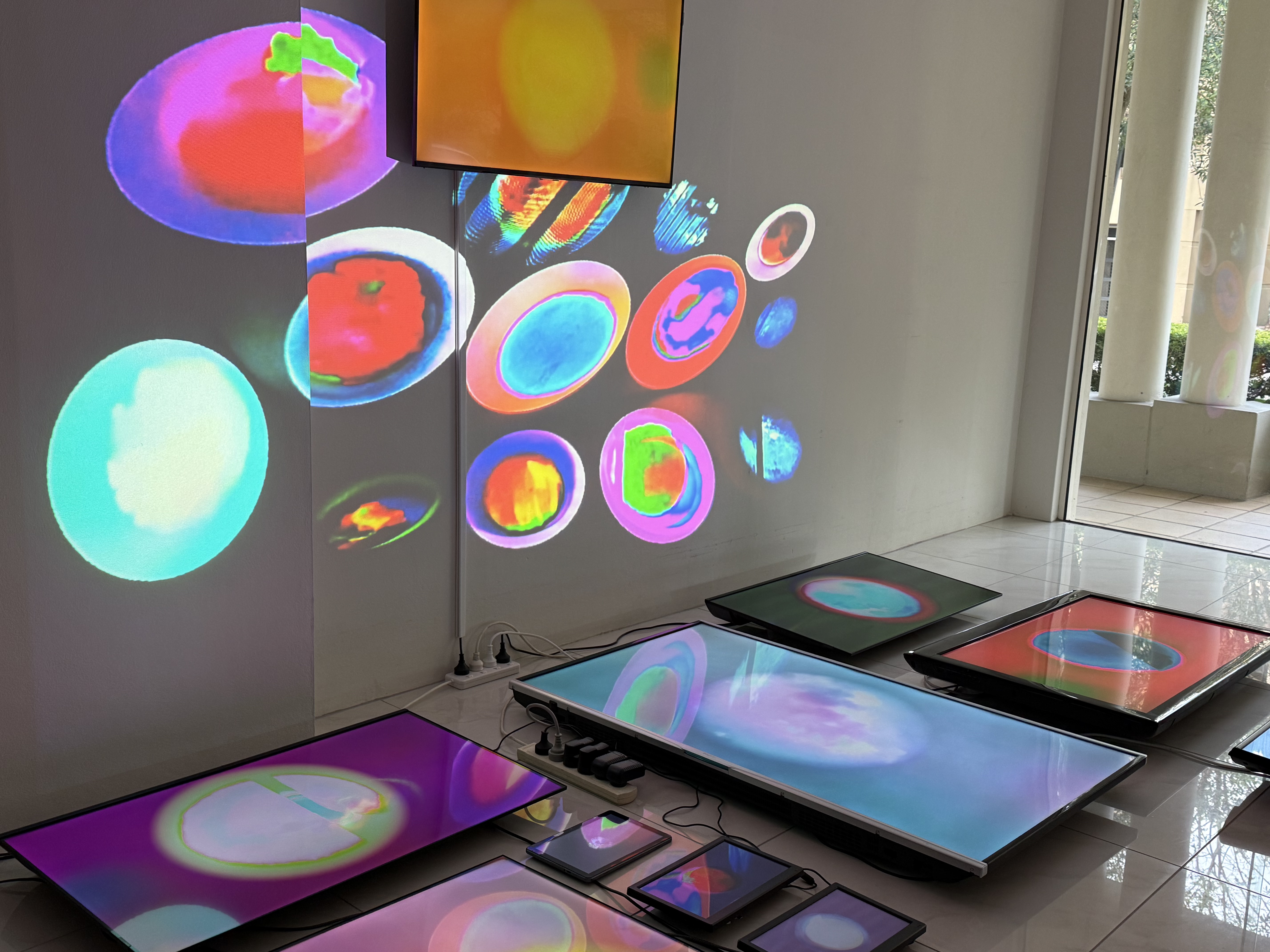
Loh’s orbs glow and pulsate light emitted from the darkness of the black screens. One screen is mounted at eye height on the wall, bathed in the light from a projector. Ten screens of various dimensions, from 12" to 52", are placed on the gallery floor, reminiscent of Richard Serra's Casting (1969) work, lifting the installation beyond a purely pictorial object [5]. Loh's screens are placed in both vertical and horizontal orientation on the floor adjacent to the wall and horizontally on the wall, which extends Serra's horizontal floor layout. Circular reflections fill the floor gaps between the display devices. The orbs are beautiful to look at, the colours are harmonious and they fit within what Peter Schjeldahl calls Baudelaire's definition of beauty as a "spark between something fleeting and something timeless" [6] in both concept and visual aspects. Loh's light-filled orbs quiver, as the exhibition title suggests. Circular patterns of colour, oscillating fields of light-based electromagnetic frequencies create space within the installation. This work is one of pure light, with the screens emitting light from the electronics within. It's a sharp contrast to traditional paintings where layers of paint cover the canvas, representing light within the frame.

Scientific research on light shows that like wind, light can push objects in its path [7], it creates movement. Loh's orbs are activated, the wisps of colour move slowly around the form, and pulsate like the activation of energy in the electrons themselves. We're seeing frequencies of light moving at its most basic level. Light has been studied throughout time, from Euclid of Alexandria in his c. 300 BC Optica record of observations [8], to Isaac Newton's 1704 book Opticks and Michael Faraday and James Clerk Maxwell's work on the electromagnetic spectrum in the 1800s through to Werner Heisenberg's self-titled Heisenberg Uncertainty Principle effectively noting that "existence at the quantum level seems to be metaphysical rather than material" [9]. Karen Barad notes that matter and meaning are entangled at the atomic level and cannot be separated [10]. We're seeing light as consciousness, at the quantum scale [11] imagined by Loh's orbs. These lights are both borderless in their reflections and contained within their screens.

-- by Kath O'Donnell, May 2026

References
Barad, Karen Michelle. 2007. Meeting the Universe Halfway : Quantum Physics and the Entanglement of Matter and Meaning. Duke University Press. https://doi.org/10.1515/9780822388128.
Invisible Art Space. 2026. Invisible Art Space. Accessed on 25 May, https://www.invisibleart.space.
Krauss, Rosalind. 1999. A Voyage on the North Sea - Art in the Age of the Post-Medium Condition. London: Thames and Hudson. https://monoskop.org/log/?p=7009.
Linda Loh. 2026. Linda Loh. Accessed on 25 May, https://lindaloh.com.
Merillat, Christian. 1997. The Gnostic Apostle Thomas: "Twin" of Jesus? The Gnostic Society Library. http://www.gnosis.org/thomasbook.
Pickering, John, and Hall, Katie. 2015. Orbs and Beyond : Communications and Revelations from Another Reality. New York: John Hunt Publishing Limited. ProQuest Ebook Central. https://ebookcentral.proquest.com/lib/qut/detail.action?docID=1964084.
Plato. 1999. The Symposium. Penguin Books (Great Ideas). Translated by Christopher Gill and Desmond Lee.
Schjeldahl, Peter. 2019. Hot, Cold, Heavy, Light, 100 Art Writings 1988-2018. New York: Abrams Press. Kindle eBook edition.
Underwood, Sandra. 2009. Orbs, Lightwaves, and Cosmic Consciousness. Bloomington, Indiana: Xlibris.

Footnotes
[1] (Pickering and Hall 2015, 15-28)
[2] (Merillat 1997, 15-16)
[3] (Plato 1999, 26-27)
[4] (Pickering and Hall 2015, 115)
[5] (Krauss 1999, 26). Image of Serra’s Casting (1969) shown in Krauss.
[6] (Schjeldahl 2019, 376)
[7] (Pickering and Hall 2015, 25)
[8] (Pickering and Hall 2015, 129)
[9] (Pickering and Hall 2015, 129-132)
[10] (Barad 2007, 20)
[11] (Pickering and Hall 2015, 114)
[12] (Underwood 2009, 137-9)

shimmer in the blockchain landscape

Howard Morphy writes about the Australian Aboriginal Yolngu peoples' concept of Bir'Yun – the transformation of a cultural painting from the rough, dull contour of the underpainting to the brilliance of the final work, which is filled with crosshatching to indicate “a shimmering quality of light which engenders an emotional response” [3]. Morphy suggests this idea operates cross-culturally [3]. Morphy and Deborah Bird Rose extend this concept to the shimmering pulses of life — seasons, new life, sun glistening on rippling water [3], streams of light in the landscape and the interconnections, emergence and withdrawal between interacting species, those termed as having symbiotic mutualism [4].

Shimmer requires a process of transformation – energy translating from one form to another, from dullness to brilliance. ​

"Nothing is connected to everything, everything is connected to something" notes Donna Haraway [1] via Thom van Dooren [5]. Mapping this to a network topology to see a visualization of it shows similarities with peer-to-peer networks and the topology of decentralized blockchain networks. These network maps or topologies of interconnections based on this idea can be seen in ecology also from high level view, such as species' interactions with each other and their environments as well as down to the low level view of cellular / organelle evolutionary mappings created via the symbiotic interconnections idea proposed by Lynn Margulis' 1960s serial endosymbiosis theory (SET)[2]. From a topological view, we can see that the decentralized network topology of ecology is similar to the decentralized topology of the blockchain.​

If landscapes in the physical world shimmer due to the interconnections and relationships between species, their habitats and the land in their physical environments, do digital landscapes on the blockchain shimmer as well? This exhibition is a speculative exploration of these ideas, using the underlying approach of placing extinct species onto the blockchain via my specture research project. In an attempt to de-centre the human, and see the species’ view: what would the landscape and habitats look like in their new digital environments; would they shimmer as well?​

[ continued ... ]

::: location:

specture in relation to everywhen

I interpret the term Everywhen as being related to First Australians’ concept of place, time and story aligning with Country and the Dreaming — everything existing in time forever, all at once (Neale and Kelly 2020; McGrath, Rademaker and Troy 2023; Perkins and Langton 2010).

In practical terms, my works are digital JavaScript code-based drawings recorded and securely validated on the Tezos blockchain and hosted on IPFS (public filesharing nodes/servers). They are viewable in a web browser via a computer, personal device, monitor or projector/screen. The drawings include 3D models of the species that I’ve either created from 2D contour line drawings extruded to 3D or physical handmade models which were lidar / 3D scanned to create their digital forms. By storing the species onto the blockchain, it is a type of archiving of them, which raises questions especially if their forms have been altered during the conversion to digital and/or upload/minting process — archives, whilst definitely useful, can never describe perfectly the original species / artifact, and also may introduce biases and errors into the understanding of the original. We should endeavour to save the species now, rather than letting them become extinct.

The code-based drawings containing digital species creates a new ecology for the species — a digital ecology, a queer ecology (Morton 2010; Seymour 2013). The species' form has changed from its original flesh-based form. At times it appears to us as uncanny, even cute, at other times it moves towards the grotesque. It is now free from the bounds of gravity and can move spatially in new ways and make new connections. Evolution's rules apply differently in the digital world — chemical-based DNA controlled features may no longer apply. A parent drawing is created containing the base algorithm, then child drawings are generated automatically once the drawing is collected/minted by the viewer. Digital features and capabilities appear based on the blockchain metadata values. Can the species continue to evolve once born / minted to the blockchain or are they fixed once the child version is created?

[ continued ... ]

::: artists:

::: location:

20240419 - post-internet art, digital fragility and new materialism

Earlier this month, I came across Estonian artist, Katja Novitskova's Post Internet work and love this more recent work: "Soft Approximation (Looking Glass Deers Kissing 04)", 2023 via https://www.instagram.com/p/CzBgKwRofU5 — the materiality of the glass as the fragility of ecology/species works well, and loving the use of colour. Forests of the future?

[continued]

::: artists:

::: location:

this is you and me by Santiago

this is you and me is a digital painting by Santiago. It is a vibrant and dynamic scene, full of expression, movement and is dream-like as well. It feels to me as the artist has captured a glimpse of latent space, replicated a scene from a dream, and/or shown us a scene from a virtual world. Figures project from the walls, with arms open wide, reaching out with purpose. All but one figure is looking away from the viewer, to the right side of the frame, to the future. What are they trying to say to us? Perhaps it's as David Sylvian sings in Orpheus: "Sunlight falls, my wings open wide. There's a beauty here I cannot deny." Yet Orpheus is a sombre, haunting version of this painting. The visual scene in this work feels lighter, brighter and hopeful.


Santiago. this is you and me. 2023. Digital painting. 1488 x 1488 pixels. Reproduced from Twitter, https://twitter.com/neymrqz/status/1634976417246228480.

Apart from the figures, the wall also draws the viewer in, inviting them to take a closer look at the drawings and plants littered around the walls. Is this an interior room or exterior wall? The use of flat, bright and highly contrasted colours, particularly the pink and orange, speaks to the digital-ness of the landscape. The pink brushstroke in top left corner feels like thickly applied watercolour, where the paint pools on first stroke and you can just see the thickness of the brush and pooling of each row of applied colour. Yet it's the digital painterly feel, the unnatural, glossy, plastic-like paint as viewed on a glass screen, rather than on a piece of paper or canvas. There's an uncanny feel about the scene: the perspective is almost one point perspective, but not quite — the edges of the walls seem to have multiple, uneven joins, shifting the position of them. Is it one wall or many morphed together? This leads back to the dream-like quality and also suggests a virtual world. Are we seeing many moving images captured as one? The paintings on the walls are bounded by expressive thin lines, that could be ink or graphite. Some look like quick, expressive sketches, others finished works. It's the scene of an artist's fertile and imaginative mind, many future and past works and ideas in varying stages of completion. There's suggestions of portraits, and also eco/bio-influences, with the many pot plants and greenery littered across the walls, many suspended in air. The wall has cutout windows, at varying levels, merging the background into the foreground, adding interest to the scene. The floor is strewn with domestic objects, adding life to the scene — stools, tables and chairs, papers, even a dog, and a person curiously kneeling in the left corner with hands covering their face. Whilst the background is predominantly flat, there is depth and shading in the figures and furniture, adding an extra dimension to them, and making them more familiar to the viewer, despite their wonky forms.

Santiago is an artist from Uruguay in South America. I'm looking forward to researching more art from this region to see local influences, but in the meantime, looking with Australian eyes, I see glimpses of references such as Brett Whiteley, Russell Drysdale, Sydney Nolan and Fred Williams, albeit unintentionally by the artist. It makes me wonder which works Stable Diffusion 2 has been trained on, and what the prompt was for this scene.

Overall, a wonderful world-building painting, which invites the viewer to spend time with it, seeing more on each viewing.

See more of Santiago's work at: Teia, Objkt & SuperRare

References
Neymrqz. 2023. "this is you and me". Tweet. Twitter. Accessed on 13 March, https://twitter.com/neymrqz/status/1634976417246228480.

::: also published at https://aliak.substack.com/p/this-is-you-and-me-by-santiago and https://medium.com/@aliak/this-is-you-and-me-by-santiago-ab96c12406d0

::: artists:

::: internet communication:

::: location:

Espacios comunes as places of connection

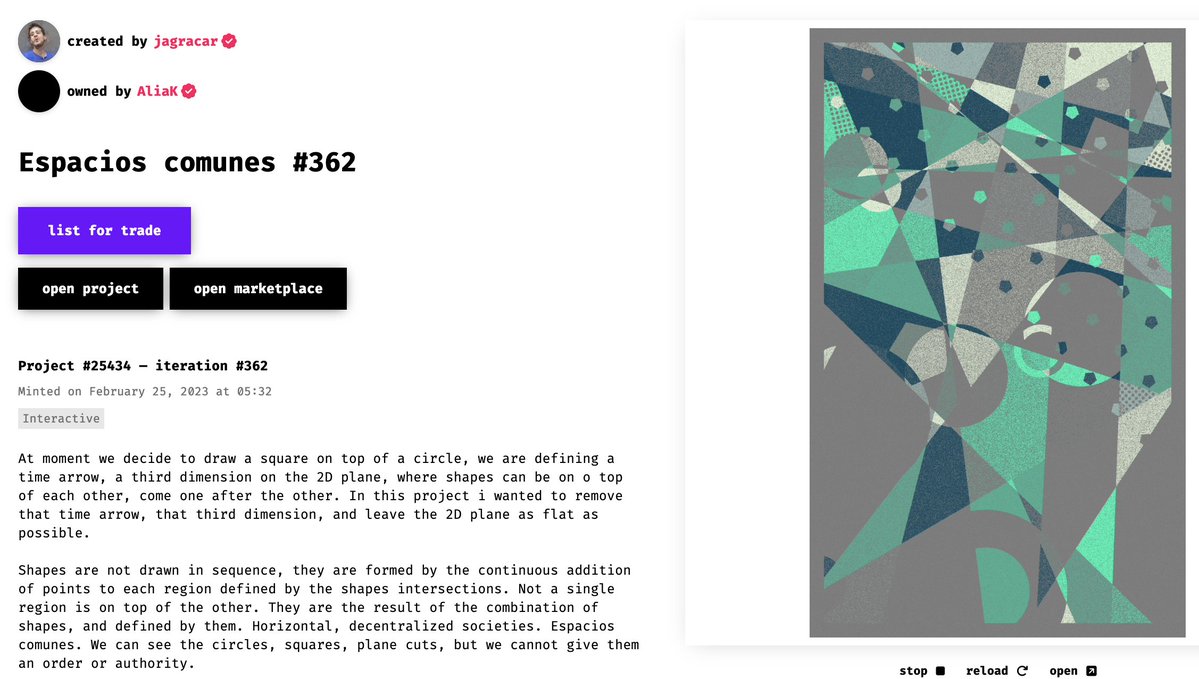
Espacios comunes is a code-based, generative artwork by Javier Graciá Carpio (jagracar) minted on fx(hash), with the main version plus 512 iterations. The drawing is made using P5.JS, with pixel sorting and added noise / texture via GLSL shaders.


Jagracar. Espacios comunes. 2023. Digital artwork. Variable sizes. Reproduced from Fx(hash), https://www.fxhash.xyz/generative/slug/espacios-comunes.

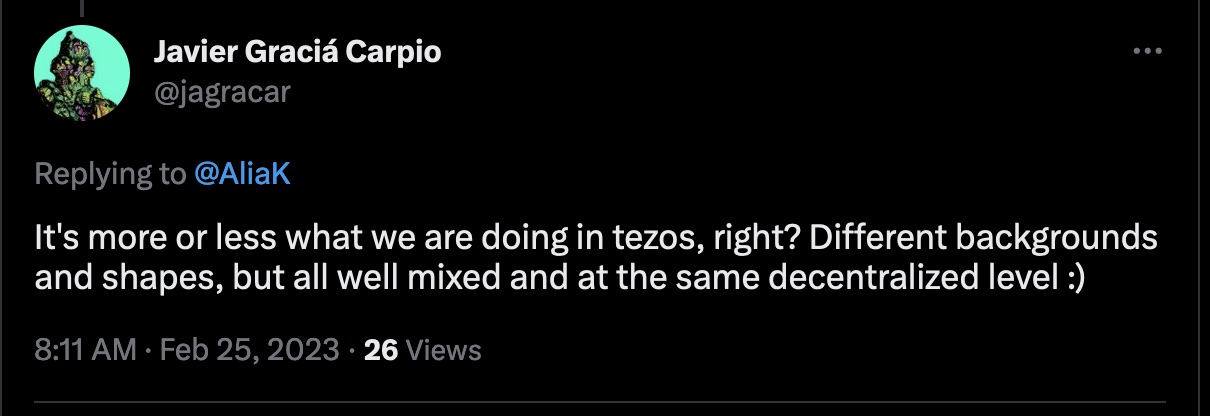
Initially I saw digital landscapes built up from atoms/points, forming over time. After reading the artist's description and translating the title as common spaces, I interpret the artist's intention of a collection of spaces as more socially based places. Jagracar describes the work as: "Horizontal, decentralized societies. Espacios comunes. We can see the circles, squares, plane cuts, but we cannot give them an order or authority" and further explained via a tweet: "It's more or less what we are doing in Tezos, right? Different backgrounds and shapes, but all well mixed and at the same decentralized level :)" By adding the social aspect to these spaces, Jagracar has reinforced their use as places — this fits with my research on the exploration of the blockchain as not a placeless space, it is actually a Place in the architectural and geographical theory sense, due to the communities active on it and social aspects. Jagracar's views of Espacios comunes could be seen as the topographical map, extending from and sitting alongside Paul Baran's decentralised network topologies diagram (as used by Vitalik Buterin also), to see the societies' view — another view of Haraway's tentacular thinking, where the interconnections between nodes/communities are closer, as with Tezos and its communities themselves.


Jagracar. "Tweet". 2023. Image of tweet reproduced from Twitter, https://twitter.com/jagracar/status/1629227616090587137?s=20.


AliaK. Paul Baran's network topology map, also used by Vitalik Buterin. 2022. Image screenshot reproduced from AliaK.com, http://aliak.com/content/specture-topology-and-context.

Espacios comunes is a durational work — the points creating the forms appear over time, drawn using P5.JS code. The points are displayed simultaneously, growing in intensity, so you see the whole image appear gradually, rather than it building different areas of the drawing sequentially — aligning to a progressive scan rather than interlaced scan; the digital over the analog. Texture is added via the addition of noise from the shaders, which are also doing some pixel sorting. In this world communities have grown in parallel, together, rather than sequentially where they would be waiting for one to start and finish before the next can be formed. The work uses varying colours from tuned palettes. Though it's described as a flat, 2D work from a conceptual perspective, the use of colours and textures applied via the shader provides dimensional and tonal aspects to the work.

The work is bounded by fixed borders, yet each iteration has a different support size. Instead of making a uniform dynamically sized work, the overall collection of iterations provides the variation in dimensions. Each collector's iteration depicts a new layout of the places, a new configuration of social interactions, new perspectives. This adds a multi-dimensional aspect to it. There are control commands which can be used to adjust the dimensions of the work, if the viewer wishes to interact with the work, in the same way that members of the communities can interact with and adjust the sizes of the communities and their involvements.

Overall, a beautiful debut for the artist on fx(hash) platform. Jagracar's earlier works can be found on Teia also via https://teia.art/jagracar
View the work and its iterations at https://www.fxhash.xyz/generative/slug/espacios-comunes

::: these notes / analysis are based on the context of my specture project research
::: also published at https://www.fxhash.xyz/article/espacios-comunes-as-places-of-connection and https://medium.com/@aliak/espacios-comunes-as-places-of-connection-d8c00...

Haraway, Donna J. 2016. Staying with the Trouble: Making Kin in the Chthulucene (Experimental Futures). Durham and London: Duke University Press.
Buterin, Vitalik. 2017. "The Meaning of Decentralization." Medium. https://medium.com/@VitalikButerin/the-meaning-of-decentralization-a0c92....
Rand Corporation. 2022. "Paul Baran and the Origins of the Internet." Rand Corporation. Accessed on 15 September, https://www.rand.org/about/history/baran.html.

::: internet communication:

::: location:

Subscribe to RSS - art writing